So the Aussie component of the trip is coming to a close. We are 4000+ kms away from 'home' in Melbourne and still have a 4 week journey in the US, but we have a lot of driving in front of us, not much else on the agenda to stop and see, but just quick over night stays to get us off the road before dusk to avoid the dangers of animals on the road.
We stopped for a night in Wiluna. This is a town that had a mining boom where the town grew to over 7000 and since, the ore dried up. The town is now only populated by about 800 people.We are in the only accommodation which is a caravan park that offered powered tent sites at the astonishingly low rate of $16.00 per night. We have been listening, since just before sunset, to the local aboriginal people sing one of four songs along to a boom box as they call out loudly to each other under a street light 100 meters from our camp site. Their song of choice seems to be "We Are the World" the Micheal Jackson song sung by a dozen or more artists in 1985 to raise funds for Africa. Dogs are barking throughout the town as young children wander the streets whacking cans with sticks while the adults chatter back and forth among wandering groups. As I've been working on several entries to the blog tonight, they have moved from the street lamp to the west to the desolate street to the east. Even my ear plugs are doing little to block the sounds so that I may concentrate on the drafts. I wonder how much good they will do me when I lay down to try and sleep?
We are off to Kalgoorlie tomorrow, but first a visit to Matt's old mining stomping grounds in Leinster. Then further south where we will stay a few nights in Kalgoorlie/Boulder visiting the "Golden Mile" where the worlds richest known gold deposit is located.
Saturday, May 12, 2012


Newman... I can't help but think of Seinfeld!
After a last dip in the fresh water pools of Karajini NP (green pool in particular)
 we arrived in the town of Newman. This town is currently a bustling mining town which is 100% booked out of accommodation. We literally rang 4 different places (the only hotels in town mind you, plus one about 10 minutes outside of town at a roadhouse) as we sat in the car in the town centre and tried to find a place to put our heads down for the night. We finally went to the caravan park in a last ditch effort to pitch our tent. Luckily they were able to accommodate us and we quickly set up before the light faded completely.
We had a quick dinner from Subway, did a load of laundry (my clothes all still have red dust permanently ingrained in them) and then listened to the labourers who were on shift change that night... bbq'ing away a gourmet meal for 20 (there was about 6 of them) listening to music and drinking copious amounts of beer, laughing and joking their way through the event.
I was long asleep before they stopped for the night, but Matt said they obeyed the 10pm quiet time (about 10 past 10) and he too was able to get a good nights sleep.
The town is expanding at a ridiculous rate and we found out how they could do so as we drove out of town the next morning. Driving south down the highway we met truck after truck of "Donga's". Portable, simple, bare-minimum housing that are in two parts, whacked together and then moved into the next day.
Friday, May 11, 2012
Tom Price Mining - Pilbara to Rio Tinto
On Tuesday, we took a mine tour of the now Rio Tinto
 run Tom Price Iron Ore mining operations just southwest of town. Bob, a very knowledgeable man who lived locally in the area took us and about 20 people from an AAT tour group (they all knew each other and had name tags on) on an hour and a half drive into the mine and to the pit look out. He had incredible knowledge about the equipment and operations of the mine as well as a very entertaining sense of humour. We watched massive Komatusu 830E 240 ton dump trucks wind their way up the pit road full of rubble from a recent blast.

I get that my home, the car we are driving around this vast land in, the building in which I sit 39 stories up above the city streets and the trains I commute daily in require Iron in some form or another to exist in their current state and certainly the settling of our westernised ways would not be nearly as it is today without the mining and use of Iron in massive quantities. But to see the raw earth in that state is hard. To know that no matter what level of rehabilitation the mining companies are required to do when the mining has finished, that literally mountains will have been removed from the horizon is quite hard to swallow. The raping of the land has never been so focused for me until we stood upon the tiny pit viewing platform hundreds of meters above the drill rigs and trucks breaking up and picking up tons of earth (waste earth at that because they were merely moving earth to get the precious vein of Iron below).
Hearing the amount of diesel that a single truck used on average (up to 20 litres per km/5.2 gal/..62 mi) in the mine and then to see the vast numbers of the machines around the place just demonstrated the sheer amount of energy consumed just to extract the ore. This ore then still has to be blended with other ore to attain export quality, be moved several hundred kilometers to the port at Dampier on the far northwest coast of Australia, sail thousands of miles across the oceans to be smelted at factories in China, then distributed world wide to be made into anything and everything that has a bit of iron in it.
Karajini National Park
We spent a few days going into Karajini NP about 50km/31 miles from Tom Price (pop. 3200??) where we parked ourselves in our trusty tent for 4, count 'em, 4 nights! The caravan park was nestled at the bottom of Mount Nameless (elev 1128m/3700 ft) a few minutes outside of town.
We had a nice grassy spot, set up cam in what seemed like a quiet location and then headed into town for a pub meal and to watch the footy (Collingwood vs. Western Bulldogs).
When we got back from town, about 8.30 or so, we discovered a tour bus full of foreign exchange students (I counted at least 30) had set up in the three sites immediately surrounding our site. They had tarps laid out, and their gear and sleeping kits piled up. Next to the bus was a kitchen assembly line, cafeteria style. Luckily, they had a group meeting and we could hear that the were headed into Hammersley Gorge the next morning, but unfortunately would be returning to our caravan park for a second night. We actively decided to avoid that are of the park and so decided to check out Mt Bruce
near the western edge and then into the heart of the park to the main attraction. Gorges that appear out of nowhere with most retaining some water year around. Seriously, if you were trotting along on a horse and did not know where you were, it would be incredibly easy to picture someone dropping off into the gorge, they come up that suddenly!
Cutting deeply through iron rich rock, the drastic nature of the gorges is stunning at a glance and fascinating with study. Being rich in iron, the rocks are the deepest shade of red.
Climbing down into the Weano, walking along the gurgling stream, weaving back and forth across the bottom of the gorge,
criss-crossing the stream until we suddenly stumbled upon a deep green pool of chilly water.
We started by putting our feet in and watching tadpoles swim around and dragon flies buzzing close to the water surface. Then we went back to the car, changed into our swimming gear and headed down to Hancock Gorge. This gorge is even narrower and the water moves quickly with stunning tiny waterfalls and dramatic 'swimming lanes'.
Making it all the way to Kermit's Pool, we finally both got into the icy water. It was tremendous. With the ridge temperatures hovering just above 30 degrees C/86 degrees F, the chill of the water was very refreshing.
Having nearly exhausted our daylight hours we trudged back to camp and made dinner at the camp kitchen where we met the current manager of the park who was here with his wife from NSW (New South Wales) for 'as long as they'll have us' taking care of the park for the owner who is based down in Perth. He told us a bit of his daily/weekly routine and how he came to be in the job.
The next day we headed back into the park, stopping at the visitors center and the heading to Joffre Falls and Knox Gorge where we once again hiked down and swam in the fresh pools deep in the canyon.

Our third day, we went to go to town and see about organising a mine tour but as we went to leave we discovered a very flat tire. Out came the spare and off to town to find a repair shop we went. Luckily, they could fix us up in a few hours so we hung around town, washed the car, made a round of phone calls to check in with people back in Melbourne and then went back to pick up the tire. Late in the afternoon we climbed to the top of Mount Nameless (Jarndrunmunhna is the aboriginal name) from camp. It was a long, steep climb, but as the sun began sinking to the west at our backs we watched the mountain turn to a shimmering red and gold before our eyes. We had a few minutes at the top to view the town, the mine and the untouched land to the north and west of the mountain.
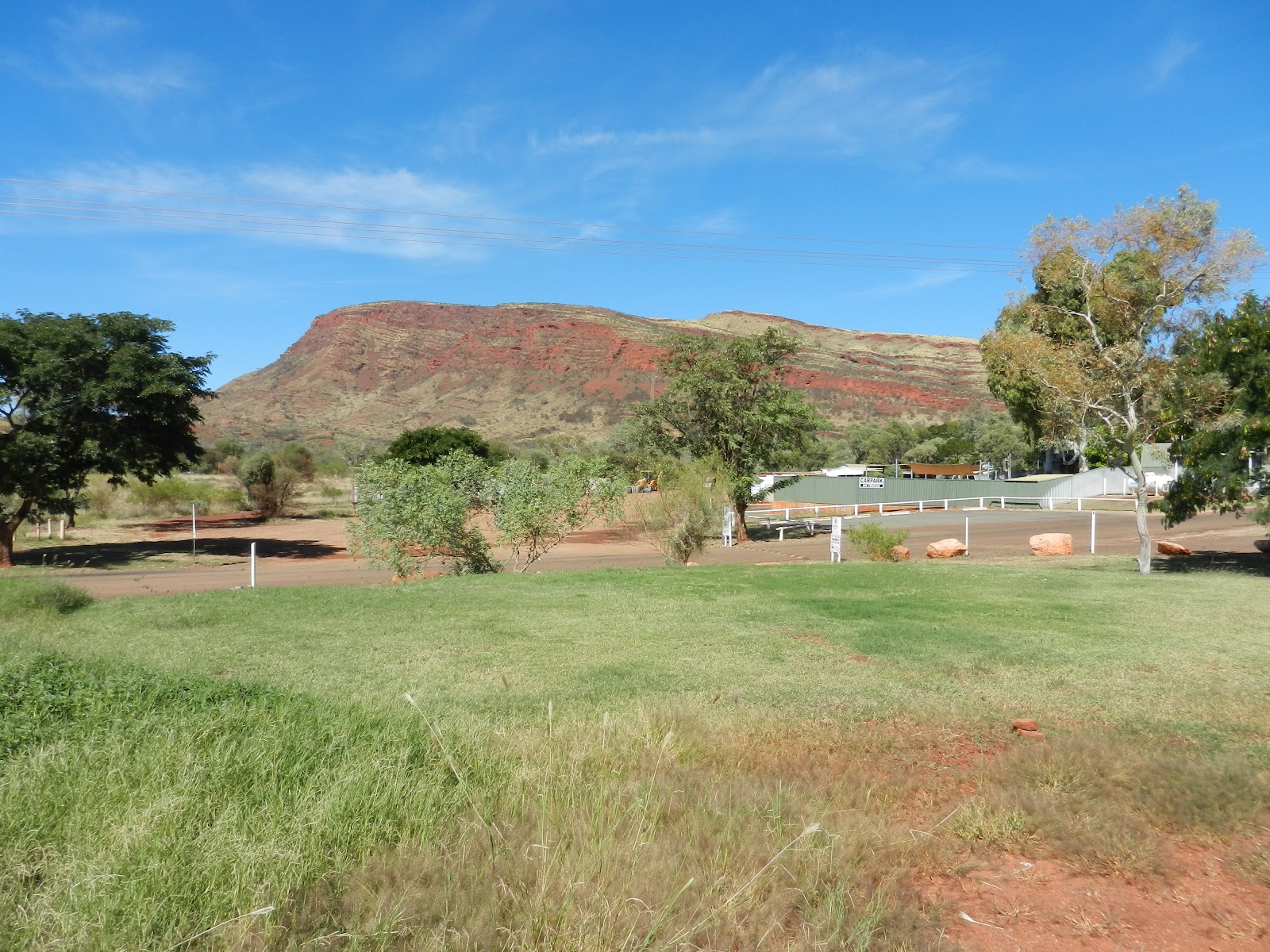 |
| Mount Nameless - Tom Price, W.A. |
When we got back from town, about 8.30 or so, we discovered a tour bus full of foreign exchange students (I counted at least 30) had set up in the three sites immediately surrounding our site. They had tarps laid out, and their gear and sleeping kits piled up. Next to the bus was a kitchen assembly line, cafeteria style. Luckily, they had a group meeting and we could hear that the were headed into Hammersley Gorge the next morning, but unfortunately would be returning to our caravan park for a second night. We actively decided to avoid that are of the park and so decided to check out Mt Bruce
 |
| Mount Bruce - Karijini NP, W.A. |
Cutting deeply through iron rich rock, the drastic nature of the gorges is stunning at a glance and fascinating with study. Being rich in iron, the rocks are the deepest shade of red.
 |
| Entrance to Weano Gorge - Karajini NP, W.A. |
Climbing down into the Weano, walking along the gurgling stream, weaving back and forth across the bottom of the gorge,
 |
| Weano Gorge - Karajini NP, W.A. |
criss-crossing the stream until we suddenly stumbled upon a deep green pool of chilly water.
 |
| Cooling my feet in a pool of Weano Gorge - Karajini NP, W.A. |
 |
| Swimming lane - Hancock Gorge, Karajini NP, W.A. |
 |
| A slippery path - Hancock Gorge, Karajini NP, W.A. |
Having nearly exhausted our daylight hours we trudged back to camp and made dinner at the camp kitchen where we met the current manager of the park who was here with his wife from NSW (New South Wales) for 'as long as they'll have us' taking care of the park for the owner who is based down in Perth. He told us a bit of his daily/weekly routine and how he came to be in the job.
The next day we headed back into the park, stopping at the visitors center and the heading to Joffre Falls and Knox Gorge where we once again hiked down and swam in the fresh pools deep in the canyon.
 |
| Matt sitting in Joffre Falls - Karajini NP, W.A. |
 |
| Signs of Flash Floods - Karajini NP, W.A. |
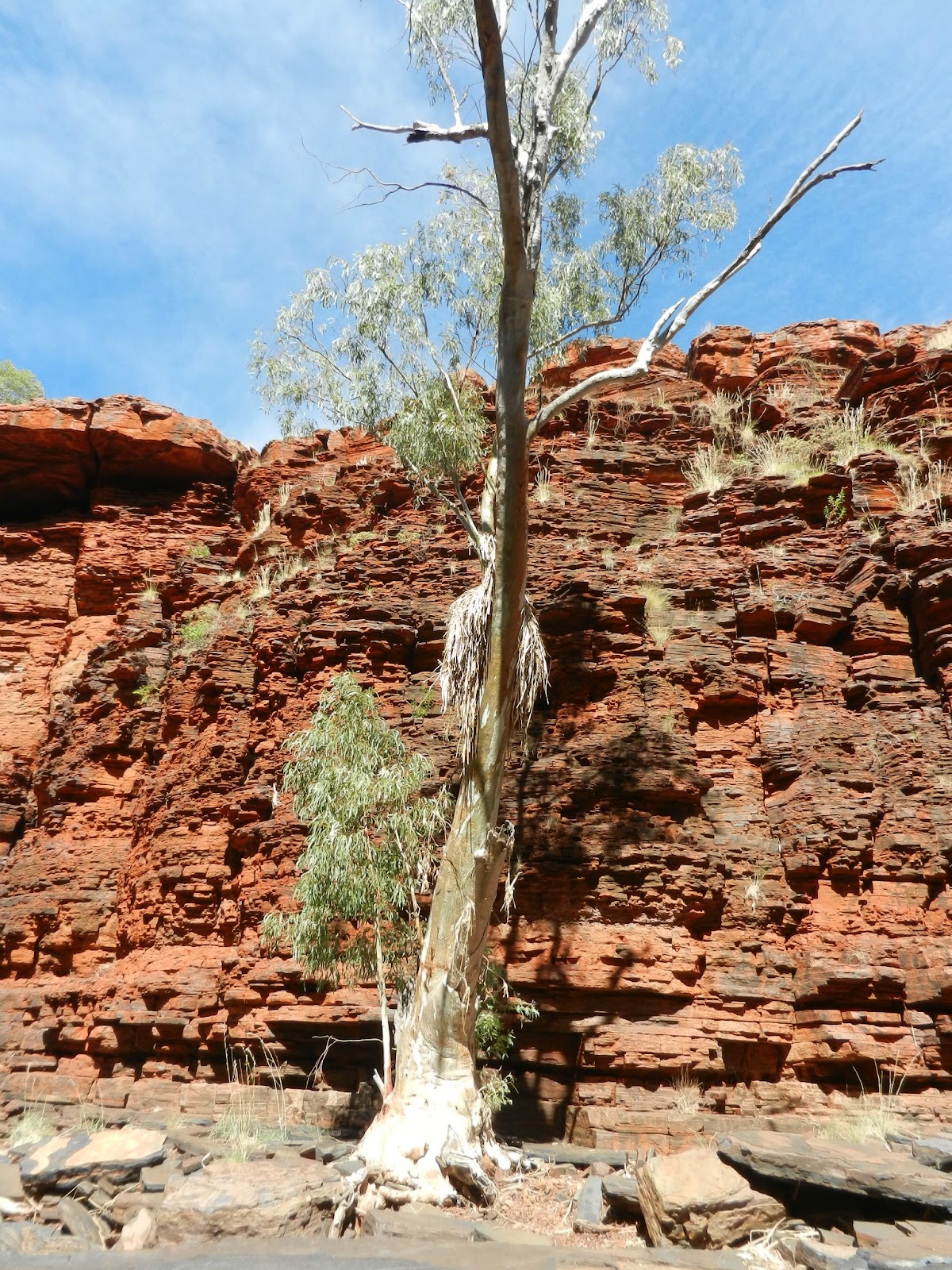 |
| Note the rubbish in the half way up the tree - Karajini NP, W.A. |
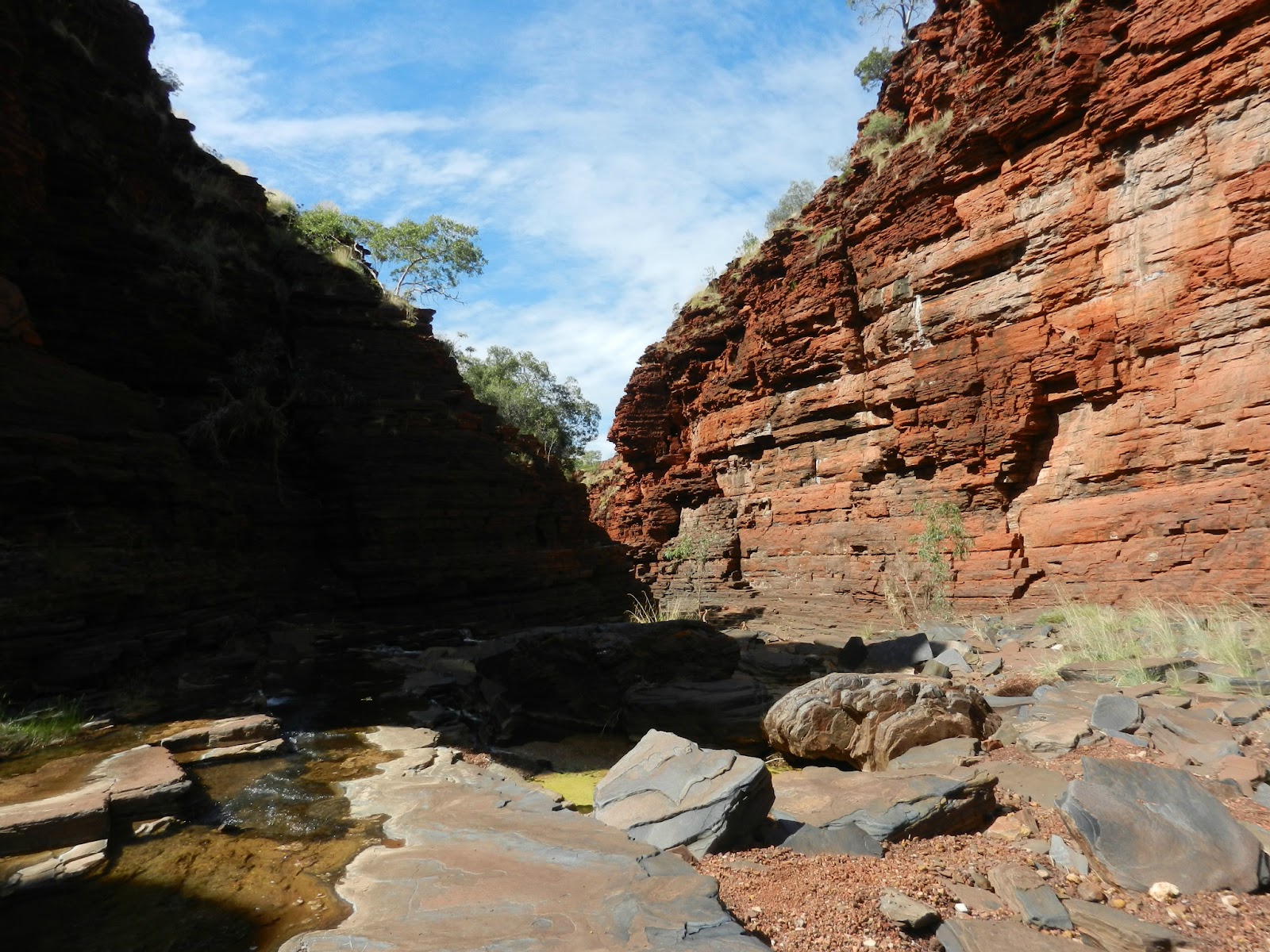
Our third day, we went to go to town and see about organising a mine tour but as we went to leave we discovered a very flat tire. Out came the spare and off to town to find a repair shop we went. Luckily, they could fix us up in a few hours so we hung around town, washed the car, made a round of phone calls to check in with people back in Melbourne and then went back to pick up the tire. Late in the afternoon we climbed to the top of Mount Nameless (Jarndrunmunhna is the aboriginal name) from camp. It was a long, steep climb, but as the sun began sinking to the west at our backs we watched the mountain turn to a shimmering red and gold before our eyes. We had a few minutes at the top to view the town, the mine and the untouched land to the north and west of the mountain.
Moving inland
After being beach bums for so long we are now making the turn towards home. Mind you, home is still 4200+ km/2600+ mi away... By the most direct route... But still, inland we turn and face entering the fantastic, terrible, amazing and boring Pilbara. An arid desert filled with pockets of fantastic scenery,
 terrible washes called floodways that can isolate an already isolated station,
 town or traveller at any moment (during the wet season!), amazing blocks of rich mineral deposits, providing the aussie dollar its international boost, and stretches of boring, flat red dust plains.

On our way out of Coral Bay, we did grab a few snaps of some terminte mounds - these huge crusty mounds were scattered all over the plains and in some areas numbering in the hundreds.
As we crept eastwards towards Tom Price, a Rio Tinto mining town with a population of 3200, we travelled over and around a handful of old mountains that had deep red exposed cliff faces heavy with iron ore and silica (didn't I tell you travelling with a geologist is fun and informative?)

The scenery had subtle changes around every corner (and there actually was some corners!) and over every hill.


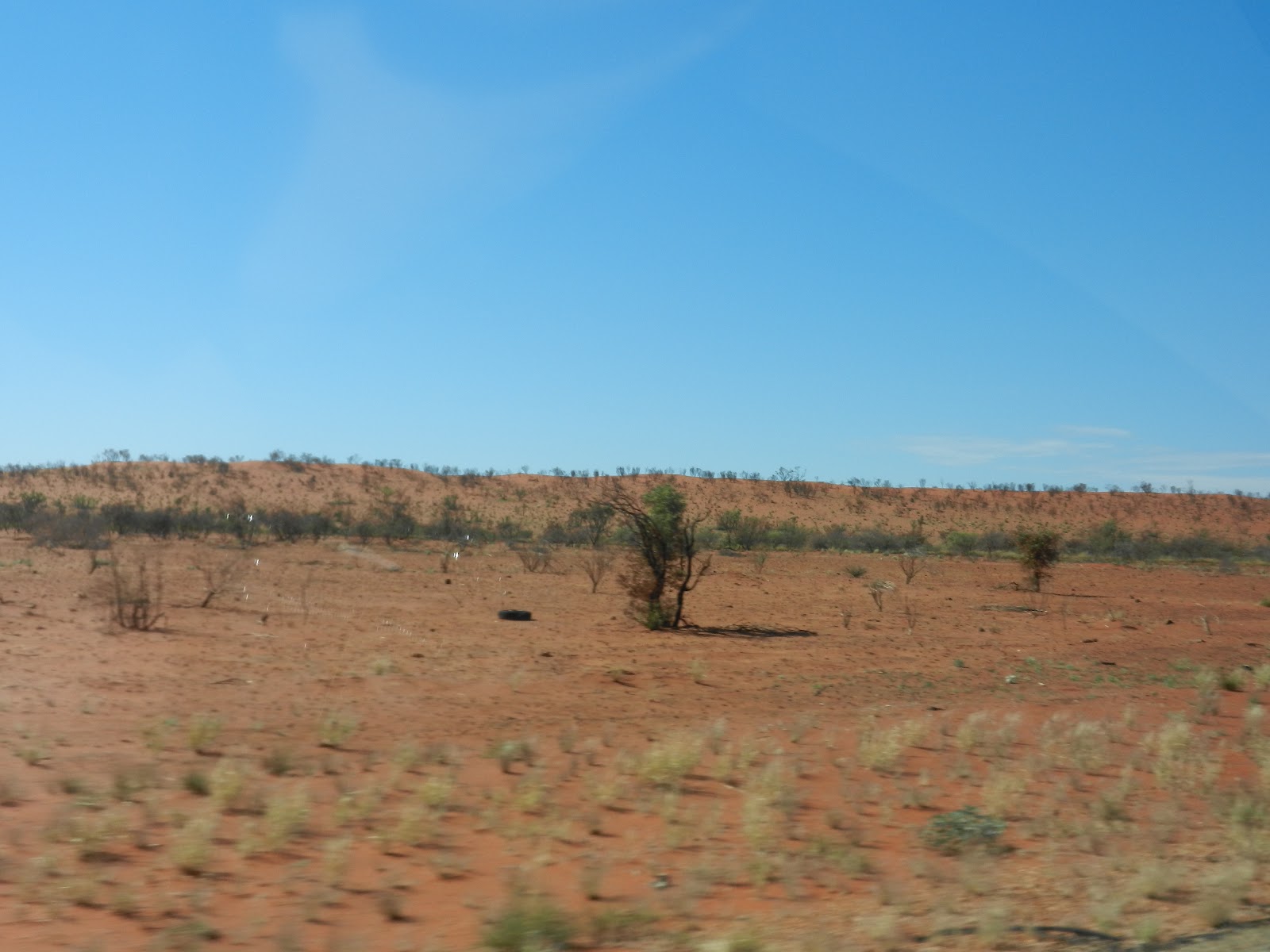
On our way out of Coral Bay, we did grab a few snaps of some terminte mounds - these huge crusty mounds were scattered all over the plains and in some areas numbering in the hundreds.
 |
| Terminte Mounds, Between Coral Bay & Exmouth, W.A. |

The scenery had subtle changes around every corner (and there actually was some corners!) and over every hill.
Thursday, May 10, 2012
Seriously... Mobile Internet can be a pain!
Sorry folks, I've got 7 posts drafted, but I am having difficulties getting photos to load and trust me, the photos are worth the wait! I'll get more posted just as soon as I can!
Sorry!!!
Sorry!!!
Sunday, May 06, 2012
Coral Bay
Ahhh... beautiful white sand beaches, amazing coral reefs just a few short swimming strokes in bath-water warm water - Can it it any better than this?
Well... it could if our snorkel gear was up to snuff. We've had some technical difficulties with our gear that has made snorkeling a little bit of a nightmare. We still persisted, however and saw plenty of giant clams, an angel fish, butterfly fish, sea cucumbers, lagoon rays and countless other types of fish we haven't been able to identify.
Certainly should be on any kind of Australian travel plans if you want a comprehensive look at what this massive country has to offer. And from my experiences, this was far better then the Great Barrier, purely because it was accessible from the beach, there wasn't any nasty jellies to worry about and the town is not all hoity-toity touristic... yet...
 |
| Coral Bay - W.A. |
Well... it could if our snorkel gear was up to snuff. We've had some technical difficulties with our gear that has made snorkeling a little bit of a nightmare. We still persisted, however and saw plenty of giant clams, an angel fish, butterfly fish, sea cucumbers, lagoon rays and countless other types of fish we haven't been able to identify.
Certainly should be on any kind of Australian travel plans if you want a comprehensive look at what this massive country has to offer. And from my experiences, this was far better then the Great Barrier, purely because it was accessible from the beach, there wasn't any nasty jellies to worry about and the town is not all hoity-toity touristic... yet...
Subscribe to:
Posts (Atom)